
I Thought Guitar Mass Would Save the Church. I Was Spectacularly Wrong.
Young Catholics aren't asking for better worship bands. They're asking for the sacred.

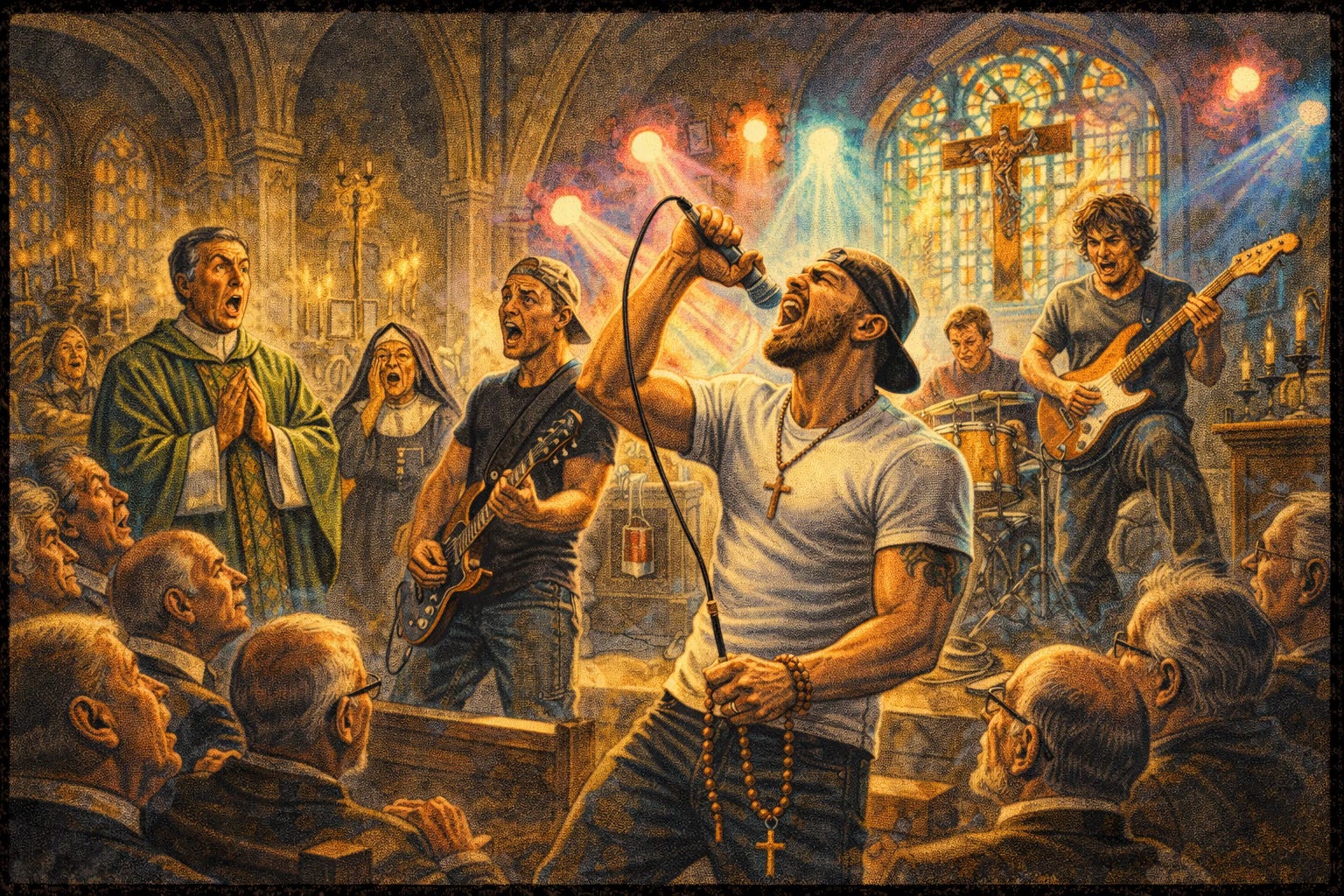
I need to apologise.
There was a time when I genuinely thought the solution to bad music at Mass was guitars and drums.
In the early 2000s I played in one of those “youth” bands that was supposed to attract young people to the Church.
I know.
We’ve all got skeletons in the closet.
We thought we knew exactly what the Church needed.
Vocal arrangements borrowed from contemporary music. Catchy songs. Repetitive choruses.
I genuinely believed this was the future.
We thought we had finally cracked the evangelisation code.
“This is how we can make Catholicism relevant to a new generation.”
I cringe when I think about it now.
Interestingly though, what I started noticing, even fifteen or twenty years ago, was that the more we tried to make things cool and relevant, the more young Catholics seemed to move in the opposite direction.
They were becoming more traditional.
I noticed this trend long before it became obvious.
One of the first moments I realised contemporary Catholic music wasn't going to bring about the revival we hoped for came during World Youth Day in Sydney.
Our Catholic band played to huge crowds, alongside dozens of other contemporary Catholic acts. The crowds were there. But after watching band after band perform, I began to realise that the music wasn't what was driving any excitement.
The Monastery That Broke My Theory
Another experience put an even bigger question mark over my belief that music could somehow revive the Church. During those years, I made several retreats to a Benedictine monastery.
The monastery changed the way I thought about sacred music.
What struck me wasn’t simply the Latin, the incense, the chant, or the beauty of the liturgy.
It was the realisation that none of it was trying to be relevant.
Nobody was trying to imitate popular culture.
Nobody was trying to make the Church feel modern.
Nobody was asking what young people were listening to on the radio.
And yet it was more powerful than anything I had experienced in contemporary Christian music.
That was the moment something clicked.
For years I had assumed that if we wanted to reach the culture, we needed to borrow from the culture.
But what I encountered at the monastery transcended culture altogether.
The chants were ancient.
The prayers were ancient.
The liturgy was ancient.
Yet none of it felt old.
It felt timeless.
It felt like I had stumbled across something that belonged to every century and no century at all.
That planted a seed in me.
I knew then the Church shouldn’t be adapting herself to the age.
I realised timelessness might be more attractive than relevance.
The Relevance Trap
Now I’m not saying the average Novus Ordo-going Catholic wouldn’t prefer talented contemporary musicians playing Hillsong-style music over a seventy-year-old organist battling her way through a dreadful hymn from 1982.
Of course they would.
Let’s be honest.
Some of the music Catholics endure every Sunday is more painful than a root canal without anaesthetic.
When the bar is that low, almost anything sounds like an improvement.
But that was once my thinking. I assumed contemporary music was the answer. I assumed that if Catholic parishes sounded more like the music people listened to during the week, young people would come flooding back to Mass.
If only we could be more like Hillsong, or whatever megachurch worship trend was dominating at the time.
They’re so cool.
So contemporary.
That’s what young people want, right?
Those bands perfectly encapsulate the culture.
The latest guitar tones.
The latest drum loops.
The polished production.
The soaring vocal harmonies.
Music so thoroughly modern it is almost indistinguishable from everything else on a Spotify playlist.
Looking back, the strategy was bizarre.
“Let’s compete with popular culture by becoming a slightly less talented version of popular culture.”
What could possibly go wrong?
The Unexpected Direction
The problem is that reality seems to be moving in the opposite direction.
The young Catholics who are most serious about their faith increasingly seem drawn to things that sound less like the culture, not more.
They want mystery.
They want transcendence.
They want beauty.
They want something ancient, sacred, and unmistakably different from the world outside.
What Young Catholics Are Actually Looking For
So the question is whether culturally relevant contemporary music is an effective strategy for attracting people to Catholic worship.
After decades of experimentation, the evidence suggests the answer is no.
In fact, we may be seeing the opposite.
Many young Catholics are not looking for a church that sounds more like the culture.
They’re looking for something that sounds less like it.
What many young people seem to be searching for is something they cannot get anywhere else.
Something timeless.
Something sacred.
Something transcendent.
Something that sounds as though it belongs to another world.
The irony is that the more the Church tried to sound like the culture, the less distinctive she became.
And the less distinctive she became, the less reason people had to choose her over everything else competing for their attention.
Young people don’t need another concert.
They need an encounter with the sacred.
The Soundtrack of Disbelief
Music isn’t decoration.
It’s not ambiance.
It is not the warm-up act before the important stuff starts.
The Church’s own documents are unambiguous.
Sacrosanctum Concilium calls sacred music an integral part of the liturgical act.
Not peripheral.
Integral.
Meaning that without it, something essential is missing.
And what has been missing for fifty years is the sacred.
When the music sounds like a Christian concert, the congregation subconsciously concludes they are attending a Christian concert.
When the music sounds like what people hear on the drive to Mass, it becomes harder to convince them that what is happening inside the church is unlike anything else on earth.
The mind doesn’t lie to itself.
When the soundtrack signals casual, the event becomes casual.
When the event becomes casual, God becomes casual.
And when God becomes casual, the Eucharist becomes a symbol and the symbol becomes optional and the optional becomes skipped.
What Happens When Nothing Feels Sacred
This also ties into another problem the Church has been wrestling with for decades. And that is the collapse of belief in the Real Presence.
Now, I’m not saying bad music is the sole reason large numbers of Catholics no longer believe in the Eucharist.
That would be far too simplistic.
But atmosphere matters.
The liturgy teaches.
The music teaches.
The architecture teaches.
Everything about the Mass is communicating something, whether we realise it or not.
The Church has always understood this.
Sacred music is not merely decoration.
It is meant to support prayer, elevate the mind to God, and help communicate the sacred mysteries being celebrated.
In other words, the atmosphere itself is preaching a kind of theology.
When the Mass feels banal, casual, or indistinguishable from ordinary life, that communicates something.
When the music sounds no different from the culture outside the church doors, that communicates something too.
At a deep level, people begin to absorb the message that nothing particularly extraordinary is happening here.
Of course belief in the Real Presence depends on catechesis, preaching, and personal faith. Those are fundamental.
But the liturgy should reinforce those truths, not work against them.
If we truly believe that Jesus Christ is substantially present in the Eucharist, then every aspect of the Mass should point toward that reality.
The music should help communicate it. The atmosphere should help communicate it. The beauty should help communicate it.
When sacred music is transcendent, timeless, and unmistakably set apart from everyday life, it helps create an environment that points beyond itself.
It reminds people that they have stepped out of the ordinary and into something sacred. Something ancient. Something heavenly. Something that does not belong to the culture because it comes from somewhere higher than the culture.
No piece of music can create faith. Only God can do that. But sacred music can help prepare the soil. It can help dispose the heart toward wonder, reverence, and worship.
And that matters when what is taking place on the altar is the most extraordinary reality a Catholic will ever encounter.
Guardians of the Liturgical Inheritance
The liturgy isn't a platform for artistic creativity. It's a received inheritance. And we are stewards before we are innovators.
That's why the Church consistently gives pride of place to Gregorian chant, sacred polyphony, Latin, and traditional forms of sacred art.
Because those forms have proven themselves over centuries.
So all the Church is saying is that the old should have first place. But in practice, it often has no place at all.
The language of God is silence. The language of man is noise.
My wife and I are so blessed to attend a TLM only Oratory with a wonderful choir and music director. Music flows into your soul.
Thank you for this article.
D.B., I am not a Catholic, but every Christian I know of every kind should be reading this. I am not here to argue doctrine. But I think nearly every Church at one point has conformed or been tempted to comform to the world, rather than to Christ, when it comes to music. And rarely nowadays do I find a Church that has sacred music. This is something that really troubles me.
Your insight into issues like these really doesn't stop at the Catholic Church. I am not a Catholic and find insight and wisdom in most of the things you put on this platform. So thank you. Never stop telling the truth, D.B. We all need it.