
The Perfect Storm: When Vatican II Met the Boomers
How the Me Generation took "participation" and used it to kill the sacred.

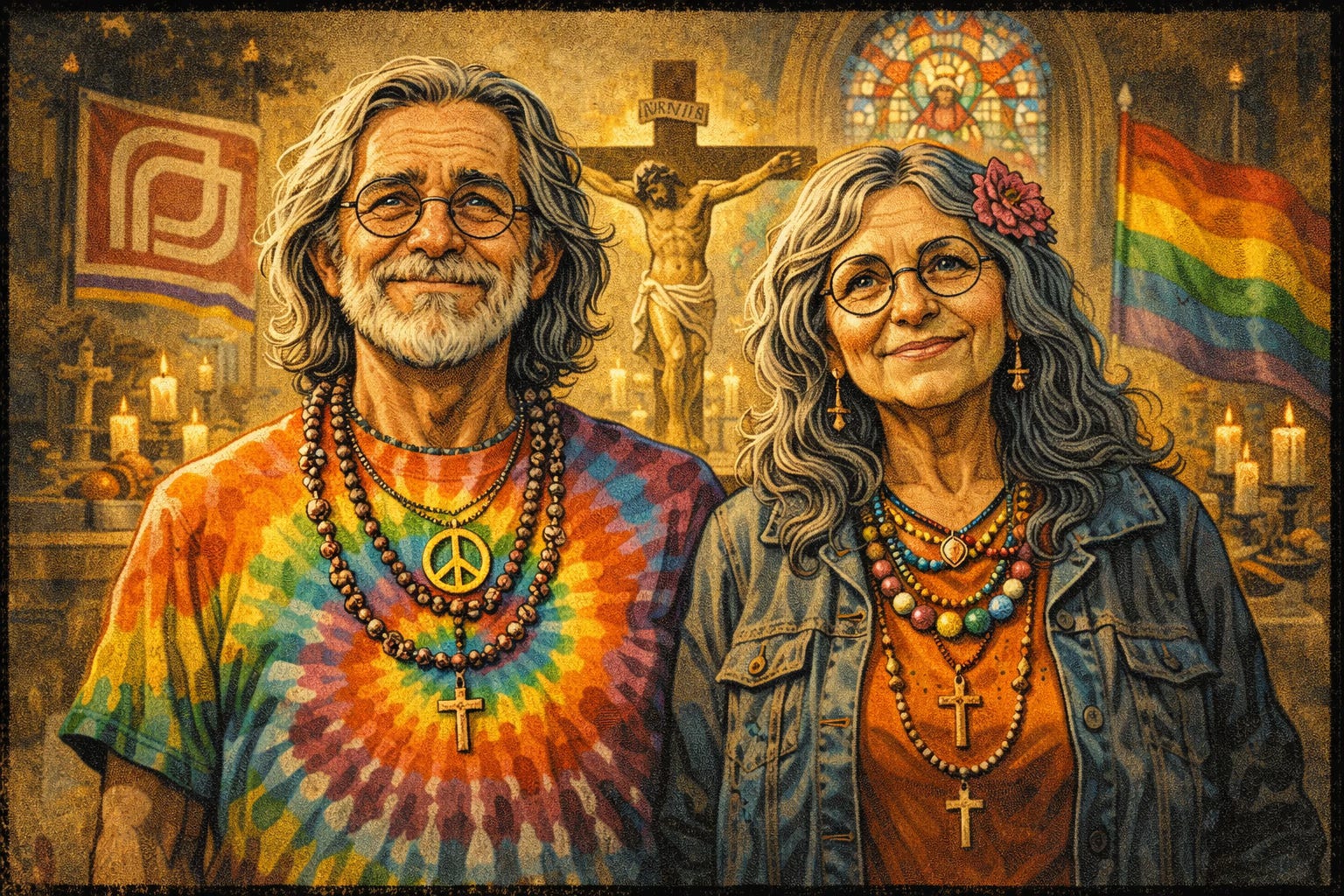
In the late 1960s, the Catholic Church said “participation” just as Western culture was exploding into self-expression, emotionalism, informality, and the cult of personal relevance. The timing could not have been worse.
So what happens when you take the Me Generation and invite them into the Catholic liturgy?
What happens when the Church hands the Mass to a therapeutic, self-expressive culture shaped by personality, emotionalism, visibility, and the obsession with relevance?
You get a liturgy slowly pulled downward from transcendence into performance. From sacred ritual into communal self-expression. From reverence into atmosphere. From worship centred on God into worship filtered through the psychological needs of the people involved.
The result after fifty years?
The slow destruction of the sacred. Reverence hollowed out. Mystery flattened. Transcendence replaced with performance, emotional management, and the cult of personality.
And along the way, generations walked out the door.
This is not an argument against Vatican II.
This is an argument against what happens when sacred things collide with a culture that no longer understands hierarchy, restraint, impersonality or transcendence.
The Post-Vatican II Atmosphere
Currently, I don’t have a parish to call home. I’m basically a liturgical nomad, wandering from Mass to Mass on weekends looking for a reverent Novus Ordo.
But that’s like searching for a unicorn.
And honestly, it’s been that way my whole life as a Catholic.
I’m just used to it. Most of us are.
You roll your eyes. Yeah, Mass is mostly bad. You look for one that isn’t as bad as your local. It becomes less about finding good liturgy and more about what you can tolerate.
That’s just been the accepted norm for decades.
You just go to your parish for the Sacraments.
I recently found myself at the Traditional Latin Mass whenever I could justify driving an hour on a Sunday.
Since then, I’ve finally figured out why I’ve struggled with Mass all my life.
Like a fish born in a polluted pond, it doesn’t know anything different until it gets a swim in a fresh ocean. Then going back to the green water is difficult.
That’s how I feel going from banal, irreverent Novus Ordo Masses to a Traditional Latin Mass, then back to a poorly celebrated Novus Ordo.
Until now, I’ve never stopped to analyse why the liturgy itself had become so bad. Why so many Masses felt banal, irreverent, beige, flat, human-centred, and spiritually weightless.
I just assumed the answer was more catechesis, more outreach, more evangelization. And all of that is true.
But why is the same thing happening nearly everywhere? I’ve heard all the theories and conspiracies. But I think there’s a number of reasons as to how we ended up here.
But one thing that massively contributed was the perfect storm of the Boomer generation colliding with the post-Vatican II era.
The Boomers and VII
The Boomers were the generation that implemented the Vatican II reforms.
And they implemented them through the lens of their own generational psychology: self-expression, informality, distrust of authority, creativity, relevance, participation, emotionalism, and the obsession with making everything feel personal and communal.
That combination changed the atmosphere of Catholic liturgy almost overnight.
After Vatican II, an entire generation interpreted “participation” as a licence for self-expression, personality, creativity, emotionalism and human ego to flood into the liturgy.
And before people start hyperventilating, obviously this is not about every individual Boomer. Plenty are faithful, holy, sacrificial Catholics who preserved the faith through chaos and deserve gratitude for it.
I am talking about broad generational psychology and cultural trends. Every generation has them. And the postwar generation had a very specific one.
The Boomers were the first fully therapeutic, self-actualised, authority-distrusting, find-yourself-obsessed generation in modern history.
They would eventually become known as the Me Generation.
The first generation raised inside mass consumer culture. The first generation taught that personal authenticity was a moral ideal.
The first generation psychologically trained to interpret reality through my feelings, my identity, my expression, my needs, my fulfillment, my journey.
Not every individual fit the stereotype. But culturally, that was the air the generation breathed.
Then the Church handed that generation the liturgy right as its generational psychology was peaking.
That combination was catastrophic.
Not because the Council failed. Because the people receiving it filtered everything through the dominant psychological assumptions of the age.
“Participation” stopped meaning interior union with the sacrifice and started meaning visibility. Expression. Creativity. Relevance. Community performance. Everybody needing a role. Everybody needing a microphone. Everybody needing to feel involved.
And modern narcissism did what modern narcissism always does.
It made the sacred revolve around the self.
Not always consciously. Not always maliciously. Often sincerely. But sincerity does not stop pathology.
The sanctuary became crowded with personalities. The liturgy became buried under human presence.
Music ministries became unresolved performance fantasies. Parish committees became consensus-management therapy circles.
The priest stopped disappearing into the rite and became a host managing the emotional temperature of the room.
This is what happens when self-expression collides with transcendence.
This is what happens when a therapeutic generation inherits sacred ritual.
They turned the liturgy into a talent show.
The Visible Symptoms
Fifty years later, the churches are empty. The young have left. Reverence collapsed. Mystery disappeared. Silence became unbearable. The Mass became beige, banal, emotionally managed and psychologically exhausting.
Now obviously this decline was not caused by one thing alone.
Sexual revolution, consumerism, secularisation, technological change, collapsing family structures, entertainment culture and the broader collapse of Western Christianity all played major roles.
But the postconciliar liturgical culture often accelerated the problem instead of resisting it.
Because instead of confronting the age, much of the Church absorbed its psychology.
And the same generation that helped dismantle transcendence is still running many parishes, still insisting the problem is everybody else’s lack of charity, rigidity or nostalgia.
Meanwhile younger Catholics are starving for silence, hierarchy, beauty, structure, mystery and sacred distance precisely because modern life gives them almost none of it.
You told the Me Generation to participate.
They participated.
Right into the ground.
What Vatican II Actually Meant
Vatican II called for active participation.
Interior engagement with the sacred mysteries. The whole assembly spiritually uniting itself to the sacrifice of Christ.
What actually happened was everyone needing a job.
The postconciliar interpretation of participation slowly drifted from contemplation into activity. The assumption became that visible involvement was automatically superior to interior participation.
So now everyone needed a role.
Readers. Ministers. Announcers. Commentators. Music teams. Liturgy committees. Hospitality coordinators. Greeters. Six extraordinary ministers distributing Communion while the priest sits down.
Everyone visible. Everyone involved. Everyone validated.
The Mass stopped feeling like something eternal descending from heaven and started feeling like a collaborative community project managed by volunteers who really want you to know they are helping.
And therapeutic modern culture loved it.
Because therapeutic modern culture interprets visibility as value.
The old liturgy was built around disappearance.
The priest disappeared into the rite. The individual disappeared into tradition. The congregation disappeared into worship.
The modern liturgical instinct increasingly reversed all of that.
Now everybody needed to be seen.
The Real Problem: Ministry Became Identity
This is where the pathology really starts.
Ministry stopped being service and became identity.
That is the key psychological shift.
Once somebody’s role in the parish becomes fused to their sense of worth, meaning, relevance or emotional importance, the sacred immediately becomes vulnerable to human ego.
And suddenly you are no longer dealing with worship.
You are dealing with territorial psychology.
The flowers are not flowers anymore. They are identity. The music ministry is not ministry anymore. It is identity. The lector schedule is not administration anymore. It is identity. The parish kitchen is not a kitchen. It is a sovereign nation-state.
Move one candle and someone reacts like you violated the Treaty of Versailles.
Because once ministry fuses with ego, any challenge feels existential.
Healthy service can adapt. Identity-based attachment panics.
That is why parish conflict often feels irrationally intense.
People are not defending liturgical principles. They are defending themselves.
And because modern culture already trains people to derive significance from visibility, emotional centrality and self-expression, parish life became the perfect ecosystem for unresolved psychological needs to attach themselves to sacred things.
Not always maliciously. Often unconsciously.
But unconscious narcissism still damages institutions.
The Music Ministry Disaster
Music ministry deserves its own category because this is where performance culture and therapeutic religion fully merged.
Again, not every music minister. Not every cantor. Some are deeply reverent and sacrificial.
But structurally, the model itself became vulnerable to personality domination.
The liturgy became the one socially protected environment where someone could pursue emotional visibility while calling it ministry.
The emotionally performative cantor. The worship leader processing unresolved emotional needs through every Communion hymn.
And because modern people confuse emotional stimulation with spiritual depth, the whole thing can be mistaken for the Holy Spirit when it’s not.
Silence disappeared. Mood management replaced reverence. The sacred became atmospheric.
The liturgy stopped being received and started being produced.
And once worship becomes something humans produce, strong personalities inevitably dominate it.
That is not even theology at that point. That is sociology.
Why the Old Structure Worked
Pre-Vatican II Catholicism understood something modernity hates.
Humans need hierarchy because humans are dangerous.
Not evil in the cartoon sense. Disordered. Proud. Emotional. Tribal. Needy. Self-seeking. Weak to trends. Weak to ego. Weak to manipulation.
The old structure assumed this from the start.
Which is why it built walls everywhere.
Clear priest and laity distinction. Clear rubrics. Clear sacred space. Clear hierarchy. Clear obedience. Clear roles.
The priest did not improvise himself into the center because the structure restrained him.
The laity did not dominate the sanctuary because the structure restrained them.
The liturgy committee could not reinvent Catholicism every six months because the structure restrained them.
The old model was not built on trust in human creativity.
It was built on distrust of human ego.
That sounds harsh to modern ears because modernity worships authenticity and self-expression.
But institutions that survive for centuries usually survive precisely because they restrain personality in critical areas.
Especially sacred ones.
The old liturgy restrained personalities through impersonality.
The priest followed the rite. The rite did not follow the priest. The music served the liturgy. The liturgy did not serve the musicians. The people submitted to worship. Worship did not become self-expression.
That impersonality was not coldness.
It was protection.
Protection of the sacred from the psychological needs of the participants.
The Therapeutic Church
Modern liturgical culture increasingly absorbed the assumptions of therapeutic culture.
The Mass should emotionally resonate with me. The homily should engage me. The liturgy should feel accessible to me. The environment should reflect our parish personality. The Church should meet people where they are.
And eventually transcendence itself started feeling offensive.
Because transcendence dethrones the self.
That is why silence became unbearable. That is why sacred distance felt alienating. That is why reverence got rebranded as coldness. That is why hierarchy started feeling oppressive.
Modern people increasingly interpreted worship through the lens of emotional comfort.
And once emotional comfort becomes central, liturgy slowly becomes horizontal.
Therapeutic. Safe. Managed. Relatable.
The gravitational center shifts from God to the psychological needs of the community.
And once that happens, transcendence begins disappearing.
Not instantly. Gradually. Like water leaking from a cracked vessel.
Why Young People Are Leaving
People keep asking why younger Catholics are fleeing toward traditional liturgy, Orthodoxy and older forms of worship.
This is why.
They are starving for objectivity. Mystery. Authority. Beauty. Structure. Silence. Discipline. Sacred distance.
Modern life already drowns them in personality, stimulation, emotional performance and algorithmic self-curation.
They do not need more of it at Mass.
They want something that does not revolve around human personality. Something ancient. Something stable. Something impersonal enough to feel sacred.
That is why many young Catholics walk into a reverent traditional liturgy and immediately feel relief.
Not because they hate participation. Because they are exhausted by performance.
The old liturgy often feels restful precisely because the personalities recede.
The structure carries the weight. Not the people.
And ironically that impersonality often creates more space for genuine encounter with God, not less.
The Experiment Failed
Fifty years later, here is the fruit.
Empty pews. Collapsed vocations. Destroyed catechesis. Seventy percent of Catholics not believing in the Real Presence. Young people gone. Reverence collapsing. Mystery evaporating.
Again, no serious person thinks liturgical reform alone caused all of this. Western civilisation itself underwent massive collapse.
But much of the Church responded to modernity not by resisting its psychology but by absorbing it.
The result was a liturgical culture that often became emotionally exhausting, personality-driven and spiritually thin.
People will sacrifice enormously for transcendence.
They will not sacrifice enormously for beige.
And in too many places, the sacred became beige. Casual. Managed. Emotionally curated. Therapeutic. Horizontally human.
The Church tried to make itself accessible to the modern world.
The modern world left anyway.
And now younger Catholics are walking back toward silence, reverence, hierarchy and mystery because somewhere deep down they know sacred things are supposed to feel sacred.
Not psychologically validating. Sacred.
The Hippie side of the boomer generation were the culprits. I’m a boomer. I wanted no change to my beloved Church. But they changed it anyway without our permission or consent and gave us something inferior telling all it was the same Church as before.
Boomers are NOT anti-authority. They were all so happy to take the clot-shot and pushed it on everyone else with 'Trust the science'🙄. When it is convenient, they reject authority, but when it makes less work for them they are all to happy to accept it. This is true of people in general but I think this was the first generation that was brought up/indoctrinated to reject any and all suffering.